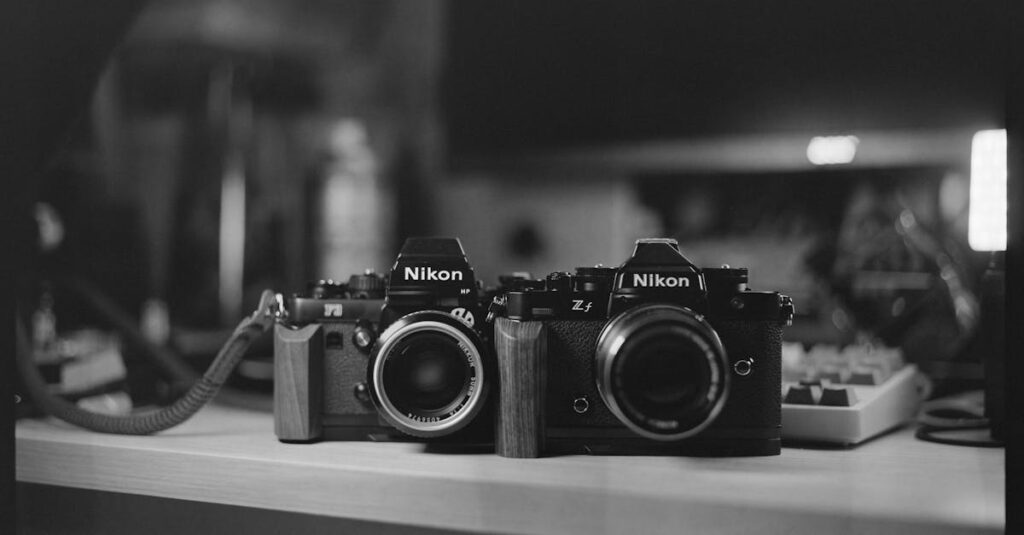
For several years, the high-end photography market has seen two giants clash: Fujifilm and Sony. Their devices, the X-H2 and the A7 IV, each embody a very distinct philosophy. While Fujifilm focuses on ingenious image quality, vintage design and advanced features for the artist, Sony caters to those looking for versatility, raw performance and broad compatibility. In 2025, these two models remain essential references, but their choice often depends on a subtle balance between creative ambitions and technical constraints. Immersed in the world of these two records of modern engineering, this article dissects their characteristics to help you make the best choice according to your photographic expectations.

The fundamental differences between the Fujifilm X-H2 and the Sony A7 IV: a technical and ergonomic analysis
At the heart of this comparison, sensor size remains a crucial variable. The Sony A7 IV has a 35mm full-frame sensor, offering an area of 858 mm². In contrast, the Fujifilm X-H2 is equipped with an APS-C sensor, measuring only 366.6 mm². This difference influences not only image quality, but also depth of field, management of high sensitivities and the ability to isolate the subject in a complex environment.

LECTURE SUGGÉRÉE
Fujifilm GFX100S vs Canon EOS R5: Which One to Choose for Professional Photography?
Fujifilm GFX100S vs. Canon EOS R5: Challenges and Specific Features for Professional Photography in 2025…
LIRE L'ARTICLEThe numbers speak for themselves: the Sony’s full-frame sensor offers more pixels in terms of area, which translates to much finer resolution for more detailed files. In 2025, it remains indisputable that this dimension confers natural superiority, particularly for large prints or low-light photography. However, the Fujifilm boasts a pixel density of 40.2 megapixels, significantly surpassing the Sony’s 33 megapixel version. This increased density ensures good resolution while maintaining smooth file handling, an essential aspect for photographers who prioritize speed and portability.
| Features | Fujifilm X-H2 | Sony A7 IV |
|---|---|---|
| Sensor | APS-C 40.2 megapixels | Full frame 33 megapixels |
| Sensor surface | 366.6 mm² | 858 mm² |
| Native ISO | 125 – 12,800 | 100 – 51,200 |
| EFV (Electronic Viewfinder) | 5760K dots | 3686K dots |
Besides the size of the sensor, another important aspect concerns the low light capability. The Sony, with its significantly larger pixels (5.12 microns compared to 3.04 microns at Fujifilm), has a clear advantage for capturing the slightest nuance in difficult conditions. Noise management is superior, making it easier to photograph at night or in dimly lit indoors. Therefore, for amateurs or professionals often working in these contexts, the Sony A7 IV appears to be a preferred option, while the Fujifilm appeals with its weight/performance ratio, particularly in travel photography or street photography.
Functionality and ergonomics: comfort of use put to the test
For optimal handling, each model prioritizes distinct ergonomics. The Fujifilm X-H2 features a top-deck display, making it convenient for quickly checking settings without looking away from the viewfinder. Its integrated phase-detection autofocus system optimizes focus in both video and stills, a significant advantage when shooting portraits or fast-moving subjects.

Canon EOS RP vs Nikon Z5: Which One to Choose for Amateur Photography in 2025?
As we approach 2025, amateur photography finds itself at a crossroads where technology continues to advance, making the choice between…
CONTINUER LA LECTUREThe Sony A7 IV, equipped with a high-resolution viewfinder (3686K dots) and a 3.2-inch tilting touchscreen, offers very pleasant overall comfort. Its NFC compatibility also facilitates connection with a smartphone, simplifying remote camera management. The shutter speed (1/180,000 second) also provides a clear advantage for capturing moving subjects or those in bright light without compromise. The built-in image stability, compatible with a wide range of lenses, allows for sharp results in all circumstances. Convenient top-deck display on the Fujifilm
- High-definition viewfinder on the Sony
- Connectivity: NFC vs. Bluetooth
- Shutter speed: 1/180,000 sec vs. 1/8,000 sec
- Ergonomic features
| Fujifilm X-H2 | Sony A7 IV | Viewfinder (EVF) |
|---|---|---|
| 5760K dots | 3686K dots | Screen |
| 3.0″ touchscreen, tilting | 3.2″ touchscreen, tilting | NFC function |
| Yes | Yes | Shutter speed |
| 1/3600 sec | 1/180,000 sec | Video quality and multimedia capabilities of the Fujifilm X-H2 and Sony A7 IV |
Video, in 2025, remains a priority for photographers looking to expand their reach or share their art. The Fujifilm X-H2 offers 8K video capture, providing exceptional image richness for editing or HD broadcasting. Its high bitrate (120 Mbps) ensures smooth video, even during fast movements.
The Sony A7 IV is also an exception, exciting the community with its compact and stabilized 4K quality at 60 fps. Compatibility with various external microphones and stereo sound management ensure high-quality audiovisual production. Its ease of use in video mode, combined with its video autofocus performance, make it a preferred choice for professional videographers and demanding amateurs.
8K sensor for the Fujifilm
- 4K recording at 60 fps for the Sony
- Higher bitrate (120 Mbps) vs. 600 Mbps
- Built-in stabilization for smooth video
- Battery life, storage, and connectivity: what are the challenges in 2025?
In terms of battery life, the Sony A7 IV benefits from a battery offering approximately 580 shots, which remains adequate for professional requirements. The Fujifilm X-H2, with its more powerful battery, shoots up to 680 shots, a notable advantage in the field. Storage capacity is also a strategic consideration. With its dual UHS-II SD card slots, both cameras guarantee maximum flexibility for successive shoots.
Wi-Fi, Bluetooth, and NFC connectivity are now standard. The Sony facilitates instant communication with a multitude of devices, including smartphones, for rapid image management. Compatibility with accessories such as microphones or HDMI monitors further expands creative possibilities. In terms of connectivity, the Fujifilm relies more on intuitive management via its interface, offering quick access to essential settings, such as white balance or exposure. Key Features
Fujifilm X-H2
| Sony A7 IV | Battery Life (CIPA) | 680 shots |
|---|---|---|
| 580 shots | Storage | 2 UHS-II SD slots |
| 2 UHS-II SD slots | Connectivity | Wi-Fi, Bluetooth, NFC |
| Wi-Fi, Bluetooth, NFC | What specific criteria should you consider when choosing between the Fujifilm X-H2 and the Sony A7 IV in 2025? | To make an informed choice, you need to ask yourself the right questions. First, what are the main uses? Studio photography or travel photography? Video or pure photography? Then, what are the logistical constraints, such as weight, compatibility with existing lenses or accessories? Finally, is there a preference for a particular lens ecosystem? |
Here’s a summary to guide your decision:
Low-light photography
: Choose the Sony, thanks to its larger pixels and extended ISO up to 204,800.
- Creative flexibility : Opt for the Fujifilm with its screen for precise framing and better video focus management.
- Weight and portability : The Fujifilm is lighter and ideal for long outings or street photography.
- Videography : In 8K or 4K at 60 fps, Sony offers a wider and more stable range. Budget:
- In general, Fujifilm cameras are often offered at a lower price, especially considering the range of compatible lenses. See this resource for a comparison. Outlook and Innovations in 2025: The Competition between Fujifilm, Sony, and Their Rivals
- In 2025, the competition between Fujifilm, Sony, Canon, Nikon, Panasonic, and other brands like Olympus and Leica is unabated. Each manufacturer is investing heavily in miniaturization, image quality, and smart connectivity. The rise of mirrorless cameras, with innovative features such as artificial intelligence for autofocus and scene recognition, is transforming the way we capture reality. Cameras like the Fujifilm X-H2 and the Sony A7 IV embody this new era, where shutter speed, ISO sensitivity, and video quality combine to push imaginable limits ever further. Compatibility with lenses from prestigious brands such as Sigma and Tamron has also helped make photography more accessible, while maintaining extreme precision. Discover our camera comparison: analyze the performance, features, and prices of the best models on the market to choose the camera that perfectly suits your needs. Frequently Asked Questions (FAQ)
What is the key difference between the Fujifilm X-H2 and the Sony A7 IV for night photography?
The Sony, thanks to its larger pixels and higher native ISO, offers better low-light performance. For more detailed information, see this comparison.
Which is lighter: the Fujifilm X-H2 or the Sony A7 IV? : The Fujifilm X-H2 is generally more compact and lightweight, ideal for those who prioritize portability, whether for travel or street photography. See this analysis.

: The Fujifilm X-H2, often less expensive, offers excellent image quality with simple ergonomics. Brands like Olympus and Panasonic also offer affordable alternatives. More details on this comparison tool.
- With this in mind, it becomes clear that the choice between the Fujifilm X-H2 and the Sony A7 IV depends primarily on your usage, your budget, and your handling comfort. In 2025, the challenge is to identify the platform that will best support your creative and technological development, whether it’s a landscape dream, a video project, or an urban planning report.


