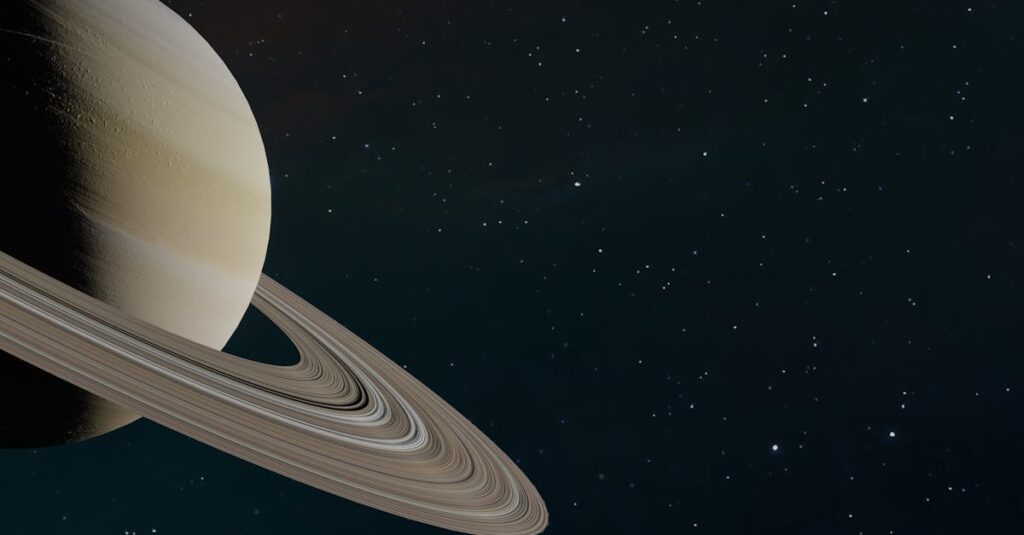
In 2025, the universe still holds many surprises for those who scrutinize its mysteries using cutting-edge technologies. The James Webb Space Telescope, a collaboration between NASA, ESA, and CSA, marks a major milestone in modern astronomy with the publication of its first-ever image of an exoplanet, TWA 7b. Located more than 111 light-years from Earth, this planet, comparable in size to Saturn, reveals a new face of the cosmos. Its observation ushers in an era where the understanding of extrasolar planets becomes more tangible, while revealing the unprecedented power of today’s optical instruments. The technical achievement of this image, captured by the most powerful telescope ever launched, testifies to the incredible progress in the fields of astrophysics and cosmology, while raising questions about our future discoveries. This is a crucial milestone for science, which affirms that behind every image lies a multitude of questions about the formation, composition, and evolution of worlds beyond our solar system.
The scientific context of the discovery: an exceptional collaboration between space agencies and optical companies
For several decades, space exploration has continued to push its boundaries, with NASA leading the way since the Apollo missions. However, this collective experience has been enriched thanks to the participation of other international stakeholders, notably the ESA (European Space Agency) and the CSA (Canadian Space Agency). Their collaboration has led to the development of innovative technologies, integrating cutting-edge optical elements, which have shaped the success of the James Webb. The objective was clear: to exceed the limits imposed by previous telescopes, notably the Hubble, in terms of sensitivity and resolution. To achieve this, the design of advanced optics, combining precision and robustness, was essential, particularly in the manufacture of segmented mirrors capable of maximizing the collection of infrared light. The synergy between these institutions has made it possible to structure a mission where each component, from the optical system to the instrumentation, is designed to observe objects in the distant universe with unparalleled finesse. The achievement of such a mission would not be possible without these joint efforts, illustrating the strength of a collaborative approach in such an ambitious field.

LECTURE SUGGÉRÉE
Fred Meylan unveils a captivating exhibition of intimate and sensual photographs that you absolutely must see.
A rare opportunity to delve into the intimate, sensory, and artistic world of Fred Meylan…
LIRE L'ARTICLEThis partnership also makes it possible to combine industrial know-how and fundamental research, capitalizing on the advances of companies like Airbus, to manufacture extremely precise optical components, essential for capturing infrared light emitted by very distant or very cold objects. With this in mind, the development of innovative optical systems is accompanied by a reduction in optical disturbances, such as diffraction or thermal noise. These developments contribute to images of unprecedented clarity, allowing astrophysicists to observe exoplanets such as TWA 7b with impressive sharpness. The observation of such planets, previously considered near-impossible, becomes an achievable goal thanks to technology developed under the supervision of specialists in optics and astrophysics, elevating space research to unprecedented heights. James Webb’s Technological Advances: A Revolution in Exoplanet Detection and Imaging
The James Webb’s success in observing exoplanets is largely due to its optical innovations. Compared to Hubble, its infrared performance allows access to previously inaccessible details. A sophisticated optical system, combined with sensitive sensors and advanced coronagraphy techniques, allows it to mask the star’s bright light to better reveal the presence of the planet orbiting it.
Specifically, its instruments use advanced infrared filters capable of isolating the light emitted or reflected by an exoplanet. This makes it easier to differentiate between starlight and planetary light, which is often very faint in comparison. Coronagraphy technology, which covers a wide range of optical angles, is based on a simple principle: by creating a hole in the light, it reveals the cold matter around a star, such as dust disks or a nascent planet. This method was perfected thanks to the precision of the telescope’s optics, the manufacture of which was entrusted to Airbus and Thales, specialists in complex optical systems. Technology

Discover the artistic world of Floress’Art: painting, sculpture and photography on the menu
In the heart of the Lot Valley, the Floress’Art exhibition captivated art lovers in 2025 by bringing together an exceptional…
CONTINUER LA LECTUREAdvantage
| Impact | Segmented Optics | Maximizes infrared light collection |
|---|---|---|
| Allows observation of very faint objects | Coronography | Masks out bright starlight |
| Reveals nearby exoplanets | Increased sensitivity | Captures fine details |
| In-depth study of planetary atmospheres | The first images of exoplanets: a window on other worlds | Since the official release of its first image, the James Webb telescope has provided a glimpse into a new facet of the universe. The image of TWA 7b offers a new perspective on planetary formation, revealing the hot material surrounding the star TWA 7, as well as the apparent hole in its disk that indicates the presence of a planet. The telescope’s ability to mask starlight to reveal faint or cool objects marks a turning point in astrophysics. This kind of image, obtained through direct observation techniques, opens the way to an improved understanding of the atmospheric composition, orbital characteristics and even space weather around these distant worlds. |
In-depth analyses reveal that this view of TWA 7b could herald the discovery of new exoplanets of similar or even smaller sizes. The prospect of photographing Terra-like worlds is becoming increasingly plausible, aided by developments in optics and detection technology.
To keep pace with these advances, numerous astrophysicists are participating in international research programs, which harness both the power of space technology and ground-based laboratories equipped with high-precision optical tools. Collaboration between researchers and engineers transcends borders to make the James Webb a decisive instrument in the search for habitable worlds.
Impact and future prospects: paving the way for the exploration of terrestrial and icy worlds
The success of this first image is just the beginning of a series of promising discoveries. The next logical step is to improve sensitivity to detect smaller exoplanets, such as Earth, located in the habitable zone of their star. The imaging method used for TWA 7b will be adapted and refined to identify potentially habitable worlds with atmospheres rich in water or organic molecules.
Advances in optics will also refine atmospheric mapping, revealing the presence of gases such as oxygen, methane, and carbon dioxide, possible indicators of conditions favorable to life. These advances rely on the synergy between engineers, astrophysicists, and industrial giants like Airbus, which are designing increasingly precise equipment.
Alongside the James Webb, other programs such as ESA’s EUCLID and NASA’s future Roman telescope will open up new perspectives, amplifying this wave of discoveries. The ultimate goal remains the capture of direct images of potentially habitable worlds, marking the end of an era of indirect observation and ushering in the explicit visualization of extrasolar worlds.
Frequently Asked Questions (FAQ)
How does the James Webb detect an exoplanet?
Thanks to the coronagraphy technique, which masks the star’s light, the telescope can detect faint objects such as exoplanets in infrared. The sensitivity of the sensors and the precision of the optics play a key role in this detection.
What is the difference between the James Webb and the Hubble?
- The James Webb has larger optics and increased sensitivity in infrared, allowing it to see further, more precisely, and into areas invisible to the Hubble. It will reveal the formation of younger and colder planetary systems. What are the challenges in the search for an Earth-like planet?
- The goal is to improve the resolution and sensitivity to detect worlds in the habitable zone, with an atmosphere capable of supporting life. This requires optical innovations and enhanced international collaboration. Source:
- www.liberation.fr