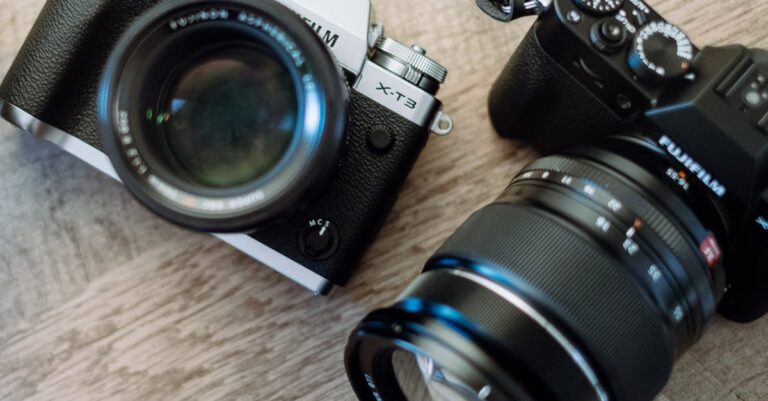
A confrontation between two compact mirrorless cameras: Fujifilm X-E4 versus Sony A6400 in the world of photography
In 2025, the mirrorless camera market is continually expanding its offerings, offering ever more powerful models to satisfy both amateur and professional photographers. Among them, the Fujifilm X-E4 and the Sony A6400 stand out for their value for money and technical finesse. These two cameras, emblems of the mirrorless philosophy, embody a strong trend toward lightweight, easy-to-handle equipment while maintaining remarkable image quality. The decision to choose between these two models is not trivial: it’s a matter of defining your priorities, whether in terms of rendering, autofocus, or ergonomics.
This detailed comparison is aimed at those who wish to capitalize on the expertise of Fujifilm, renowned for its analog film simulations, or on the technological maturity of Sony, specialized in high-quality capture. Each of these hybrids positions itself as a true extension of the worldview, balancing realism and aesthetics, without being obvious. Throughout this presentation, the technical specifications, practical performance, and user experience will be analyzed to clarify which option best suits your photographic aspirations.

LECTURE SUGGÉRÉE
Fujifilm X100VI vs Canon PowerShot G7 X Mark III: Which One Should You Choose for Your Photography?
Over the years, photography has become an increasingly accessible practice, combining technological innovation and creativity.…
LIRE L'ARTICLE
Who are we talking about? A quick overview of the key players in this photographic duel.
Fujifilm, since its beginnings in film photography, has left behind a colossal legacy in terms of color rendering, film simulations, and artistic finishing. The X-E series, notably the X-E4 launched in early 2021, continues this tradition with a sleek design that combines vintage and modern elements, as well as ergonomics designed for the creative photographer. Its 26-megapixel APS-C sensor, combined with an advanced processor, promotes rich rendering, faithful to the Fuji tradition.
Sony, with its A6400 launched in 2019, relies on a robust architecture, derived from its experience accumulated in the mirrorless field. Its major strength lies in its ultra-fast autofocus, responsive performance, and extensive compatibility with a wide range of lenses, ranging from wide-angle to portrait with an f/1.8 aperture. The model features a 24-megapixel CMOS sensor, sufficient for capturing precise details, even in low-light conditions. The Japanese brand has successfully developed this range towards perfect video mastery, while maintaining a compact profile.
This overview shows that each brand has its specific strengths, ranging from Fujifilm’s strong artistic style to Sony’s technological precision. The question then lies in whether they fit with your personal style and the priorities you set for your photography.

The Dangers of Lasers for Cameras and Camcorders
In the fascinating world of photography and videography, it is crucial to be aware of the dangers lasers can pose…
CONTINUER LA LECTURE
Intrinsic qualities and main differences in design and ergonomics
- Fujifilm X-E4: A delicate blend of vintage and modern, with a lightweight body (364g) and a sleek design. Its rangefinder format gives it an elegant silhouette, ideal for handheld shooting or long, fatigue-free sessions. Its 180° tilting LCD screen makes selfies and video easier, a real plus for content creators in 2025.
- Sony A6400: More compact (403g), but with a more recessed handle, providing excellent grip, suitable for both long sessions and heavy lenses. Its more understated, almost raw look is a benchmark for those who prioritize discretion without compromising responsiveness. The use of a 2.36 million-dot electronic viewfinder, combined with a tilting touchscreen, offers smooth and intuitive ergonomics. Criteria
| Fujifilm X-E4 | Sony A6400 | Weight |
|---|---|---|
| 364 g | 403 g | Design |
| Vintage, elegant, rangefinder | Serious, compact, modern | Screen |
| 3″ 180° swivel LCD | 3″ 180° swivel LCD + touchscreen | Viewfinder |
| 2.36 Mpts electronic | 2.36 Mpts electronic | The choice between these two types of design is partly based on the desire to favor an artistic look or more pragmatic ergonomics. The X-E4 appeals to the aesthetic sensibilities of its users, while the A6400 focuses on intuitive and robust operation. |
Responsiveness and autofocus: the art of capturing the ephemeral
In 2025, autofocus remains a key sector. The Fujifilm X-E4 deploys responsive technology, thanks to its 425 phase and contrast focus points, offering precise tracking even when moving quickly. Its start-up is instantaneous, a definite advantage for capturing the decisive moment, especially in street photography or wildlife. The burst reaches 8 frames per second in mechanical mode or 20 fps with the electronic shutter, with a 1.25x crop for the ultimate burst mode.
For its part, the Sony A6400 also boasts some of the fastest autofocus ergonomics on the market today. Its real-time detection, facial recognition, and eye recognition accelerate focus on the subject. Its burst rate tops out at 11 frames per second, but its integrated AI system offers increased precision, particularly when focusing on moving subjects. The difference is also evident in the smoothness of tracking, which is undoubtedly one of the best in its class.
Fujifilm X-E4
- : Ultra-fast start-up, burst speed up to 20 fps, efficient tracking.Sony A6400
- : Real-time autofocus, eye detection, burst speed up to 11 fps. CriteriaFujifilm X-E4
| Sony A6400 | Start-up Speed | Very Fast |
|---|---|---|
| Fast | Burst Speed (fps) | 8-20 (electronic) |
| 11 | Autofocus System | Phase + Contrast |
| AI, Face and Eye Detection | Image Quality: Sharpness and Dynamics in Two Opposite Worlds | These two cameras offer impressive performance. The Fujifilm X-E4 uses a 26-megapixel BSI-CMOS sensor, a direct legacy of the X-T4. It stands out for its exceptional film simulations**, allowing users to create unique results without complex manipulation. However, image processing tends to smooth out a little above ISO 3200, which may disappoint some demanding enthusiasts. The Sony A6400, equipped with a 24-megapixel CMOS sensor, somewhat outperforms the Fuji in noise and dynamic range management. Its highlight processing allows for finer detail recovery in underexposed areas or in bright light. The key difference lies in the Sony’s ability to retain greater detail, even in challenging conditions. |
Appearance
Fujifilm X-E4 Sony A6400 Resolution 26 megapixels 24 megapixels
Sensor
| BSI-CMOS | CMOS | ISO Noise Management |
|---|---|---|
| Blinding beyond ISO 3200 | Better control, up to ISO 6400 | Color Rendering |
| Film simulations, warm rendering | Faithful rendering, faithful to reality | Ultimately, the Sony A6400’s superiority lies in its ability to produce precise images, with better contrast and detail management in complex situations. The difference is particularly noticeable for landscape photography or demanding portraits. |
| Videos in the balance: the performance of the two cameras | If video is a selection criterion, the Fujifilm X-E4 proves very capable, offering 4K DCI capture at 30 frames per second without cropping. Its compatibility with advanced features such as Log and Electronic Image Stabilization (EIS) allows videographers to express their creativity with finesse. The video mode also includes the ability to film in Full HD at 60 fps, for smooth and precise movements. | The Sony A6400, while a benchmark in video, limits its 4K to UHD with a slight 1.2x crop, but compensates with a longer recording time, without limits. Color management, fidelity, and the ability to track moving subjects make the Sony a compelling option for professional or advanced amateur video content creation. |
| Fujifilm X-E4 | : 4K uncropped, Log, electronic stabilization, 30 fps mode. | Sony A6400 |
: 4K UHD, light crop, precise video autofocus, unlimited recording. Criteria
Fujifilm X-E4
Sony A6400
Video Quality
- 4K DCI, no cropUHD 4K, 1.2x crop
- Video FeaturesLog, EIS stabilization
| Precise autofocus, unlimited recording | Maximum FPS | 30 fps |
|---|---|---|
| 30 fps | Limitations | Automatic shutdown after 29 minutes |
| No practical limit | Learn more: we compare these two cameras in detail here for 2025 | To further your choice, don’t hesitate to consult our complete comparisons on |
| Fujifilm X-E4 versus Sony A6400 | or, for an in-depth technical analysis, the website | PXL Mag |
| These resources will provide you with an up-to-date, holistic perspective, essential for making your gear a tool that perfectly suits your style. The fundamental difference also lies in the lens portfolio available, where Fujifilm offers a more cohesive and artistic range, albeit with a certain price difference. | Discover our comprehensive guide for an in-depth comparison of products, services, and ideas. Get detailed analyses, expert opinions, and practical advice to help you make the best choice. | A question of budget and use: which of these cameras is the ideal ally? |
The Fujifilm X-E4, with its film simulations and vintage aesthetic, appeals primarily to fans of artistic styles, who love warm renderings and meticulous compositions.
The more versatile Sony A6400 is equally suited to portrait photographers as it is to sports or action photographers thanks to its fast autofocus and video options designed for content creators. Equipment prices vary, with a refurbished basic kit starting at €850 for the Sony, compared to around €899 for the Fujifilm. Accessories and additional lenses can increase the investment, but compatibility with a wide range of lenses is a major advantage for the Sony. Criteria Fujifilm X-E4 Sony A6400Introductory Price
€899 (basic kit)
- Battery Life
- Extended battery life thanks to the NP-W126S battery
- Larger capacity, up to 410 shots per charge
| Lens Range | Fujifilm X and Limited Compatibility | Large, compatible with Sony E and full-frame lenses |
|---|---|---|
| Adaptability | Retro design, film simulations, ideal for artists | Versatility, performance in video and photography |
| FAQ: Answers to your main questions about this duel of giants | Which camera should you choose for landscape photography? | The Sony A6400, thanks to its better dynamic range and its ability to capture fine details in difficult conditions, stands out slightly. |
| Which offers the best value for money for amateur use in 2025? | The Fujifilm X-E4 offers an excellent compromise between aesthetics, film simulation, and mechanical performance, ideal for beginners in artistic photography. | Are cameras easily upgradeable? |
| Yes, especially with Sony, where compatibility with a wide range of lenses allows you to expand your technical possibilities without changing the camera body. | What uncertainties remain regarding video stability? | The Fujifilm’s built-in electronic stabilization is limited, while the Sony offers very precise autofocus for tracking moving subjects in video. |
How do you choose between vintage design and pragmatic looks?
- It depends on artistic or practical sensibilities: Fujifilm is aimed at aesthetes, Sony at those who value concrete performance.