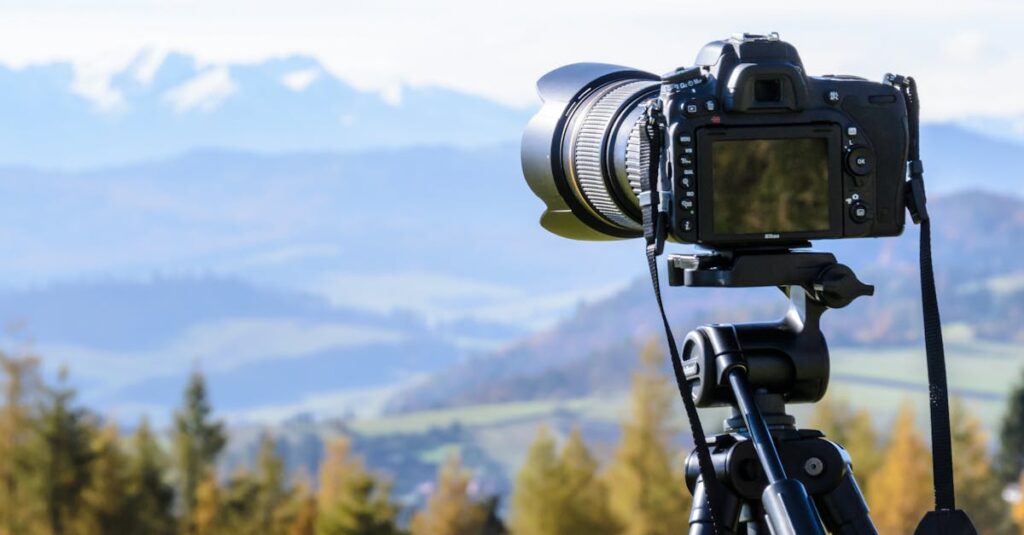
Since its infancy in the 19th century, photography has evolved to become one of the most influential and ubiquitous media in our society. From the first monochrome images to high-resolution digital snapshots, each step has marked a turning point in the way humans capture and share their vision of the world. In 2025, photography continues to evolve, integrating technological innovations and artistic practices that redefine its boundaries. The rise of mirrorless cameras from Canon, Nikon, and Sony, as well as the emergence of innovative devices like those from Fujifilm and DJI, illustrate this dynamic. At the same time, the transformation of photography is not limited to technique. It is accompanied by a shift in the cultural and societal perception of the image, giving it a central place in storytelling, event documentation, and artistic creation. The way photography shapes our relationship with reality today, between augmented reality and immersive storytelling, reflects a constantly evolving process, imbued with the legacy of innovators such as Nicéphore Niépce and Daguerre, while anticipating the possible horizons of tomorrow.

LECTURE SUGGÉRÉE
The Magic of Black and White in Photography: A Captivating Exploration
In this article, we’ll explore the magic of black and white photography. We’ll discuss its…
LIRE L'ARTICLEA rich and progressive history: the birth of modern photography
Photography has its roots in the ingenuity of visionary 19th-century pioneers. Nicéphore Niépce, considered one of the earliest experimenters, succeeded in producing the first truly still image in 1826 using a process called heliography. His image, a cityscape, required several hours of exposure in a primitive darkroom. This innovation laid the foundation for a visual revolution that would radically change the way humanity records time and space. Shortly thereafter, Louis Daguerre developed the daguerreotype, a commercial method that quickly gained worldwide popularity, allowing the reproduction of detailed images with unprecedented precision at the time. The second half of the 19th century saw the introduction of the calotype and collodion processes, which offered greater flexibility and reproduction. Photography then became a tool for documentation, science, and even propaganda, with diverse applications in the press and science. This process, often laborious and costly, has long confined the practice to an elite or specialized institutions. But, over the decades, technical developments have buffered its limits, giving rise to increasingly portable and affordable devices. The transition from heavy lenses and darkrooms to compact, high-performance cameras, such as those from Leica or Olympus, symbolizes this democratization. Photography then began to migrate towards an everyday practice, with shots taken in the street or at personal events, marking the birth of amateur photography. The renaissance of photography in the artistic and documentary sphere, supported in particular by exhibitions and publications, brought it under the gaze of the general public.
To better understand this evolution, here is a comparative table of the major stages from the birth to the mastery of modern photography:
Period
| Process / Technique | Main Characteristics | 1826 |
|---|---|---|
| Niépce’s heliography | First still image, long exposure, complex process | 1839 |
| Daguerreotype | Detailed images, rapid commercial penetration | 1850-1880 |
| Calotypes and collodion | Increased reproducibility, more flexible images | 1920-1950 |
| Portable cameras, black and white film | Greater mobility, development of photojournalism | 1950-1980 |
| SLR cameras, color film | Improved quality, artistic and commercial uses | 1980 to the present |
| Digital photography, CMOS sensors | Accessibility, instantaneity, reduced costs | Technical and practical impact: the advent of digital photography |
The decisive turning point in the history of photography came with the advent of Digital technology in the 1980s, regaining its reputation through unprecedented democratization. Cameras such as those from Canon, Nikon, and Panasonic quickly incorporated high-resolution sensors, delivering image quality previously reserved for professionals. The digital revolution led to a drastic reduction in production costs, eliminating the need for expensive film and laborious development processes. The wealth of integrated features, such as image stabilization, advanced autofocus, and synchronization with processing software, allowed amateurs and artists alike to push their creative boundaries.
This technological advancement has also introduced a new way of capturing reality, with compact cameras like GoPros or smartphones equipped with high-performance sensors. The ability to instantly see the result on a screen before even taking the photo has radically changed the practice, fostering spontaneity and creativity. The critique of photography, previously focused on technical mastery, has expanded to include visual storytelling and artistic experimentation, particularly with high-end mirrorless and DSLR cameras. Technological convergence has also led to the development of innovative methods such as aerial drone photography, with models from brands like DJI, or macro photography, which captures the smallest details of the natural world. The popularization of these techniques has influenced the way professionals and amateurs approach the practice. To illustrate this shift, here is a list of technological innovations that have revolutionized photography in recent years:

The Art of Photography: Exploring the World Through a Lens
The art of photography invites us on an unparalleled sensory journey, where each shot becomes a window onto the world…
CONTINUER LA LECTUREHigh-resolution sensors (HDR, 50 MP to 150 MP)
Advanced lenses for smartphones and advanced cameras (f/1.4, 10x optical zoom)
- Advanced built-in image stabilization
- Ultra-fast autofocus systems (or eye-tracking)
- Implementation of artificial intelligence for automatic retouching and composition
- In conclusion, the digital revolution has served as a springboard for a greater diversity of practices and audiences, making photography more accessible than ever while inspiring unbridled creativity. The Culture Actuelle platform explores this evolution in its recent analyses.
- Contemporary Photography: New Styles and Artistic Trends
Attentive to its continuous transformations, the field of photography has renewed itself by integrating various artistic forms, blending tradition and innovation. Recent years have seen the emergence of new trends such as minimalism, which favors the simplicity of forms, and visual storytelling, which constructs a narrative through a series of images. Contemporary photography, driven by digital and digital techniques, also adopts hybrid and experimental styles, particularly in the context of street photography and photojournalism. Modern cameras, from brands such as Fujifilm and Sony, offer features geared toward creativity, such as vintage film simulation or intuitive editing. The practice has also been enriched by the use of DJI drones or specialized lenses, which can be found in the online store https://journals.openedition.org/photographica/pdf/564. The use of experimental or conceptual photography today allows us to redefine what an image is, between aesthetics and message. Among the major trends shaping 21st-century photography are: Minimalism, emphasizing purity and negative space Environmental portraiture, integrating context and atmosphere
Street photography, capturing urban life in real time
Conceptual art photography, exploring ideas and processes
Digital storytelling, combining images, videos, and social media
These trends are accompanied by an increased digitalization of creation. The WebDocu platform showcases how photography is changing our relationship with the world, while highlighting the diversity of modern artistic expressions.
- Discover the art of photography through techniques, tips, and inspiration that will awaken your creativity and help you capture unforgettable moments.
- Photography as a Witness to Social and Historical Change
- Since its inception, photography has established itself as a faithful mirror of major periods of global transformation. It immortalized major historical events such as the Second World War, the space race, and the social movement of the 1960s. The power of the image thus shaped collective memory, bringing a visual dimension to often complex narratives.
- Photographs from this era bear witness to both technical and social changes. War photography, for example, revolutionized media coverage by showing the brutality of conflicts, impacting public opinion. The media coverage of major events by the press reinforced the need for innovation in the way current events were illustrated: with the gradual development of color photography, the vividness of the images increased their emotional impact.
- Furthermore, the arrival of digital photography enabled large-scale archiving and instantaneous distribution. The societal impact is now significant. Social media, particularly Instagram and Facebook, fosters the creation of communities around specific themes, promoting a participatory and instantaneous approach to storytelling. The Photo Expo platform offers a detailed analysis of these phenomena.
Current Trends and the Future of Photography in Popular Culture In 2025, photography will be fully integrated into popular culture, blending technological innovation and new social behaviors. The trend toward livestreaming, instant photography via smartphone or drone, and the use of artificial intelligence for editing, reflect a daily life where images are intended to be immediate and universal. Iconic brands such as Leica and Olympus offer increasingly powerful cameras, sometimes connected to augmented reality applications. The popularity of photography on social media, with platforms like TikTok and Instagram, has reinforced these trends. The artistic practice has become more popular thanks to the existence of specialized training and online communities, particularly via Clicovia. These developments are also influencing the style of creators, who oscillate between documentary, visual art, and experimental photography. On the horizon, technology promises to innovate further. Immersive photography and virtual or augmented reality experiences, in collaboration with giants like DJI and GoPro, will undoubtedly be at the center of this transformation. The vision of the world between realism and imagination is becoming more pronounced, while the integration of artificial intelligence could also revolutionize creation, offering hybrid or generative works. To track this evolution, the New Art of Living platform explores new trends, offering a comprehensive overview of the innovations that will shape the photography of tomorrow.
How has technology transformed the practice of photography?
It has made photography more accessible, instantaneous, and creative thanks to sophisticated cameras like those from Sony and Panasonic, integrating artificial intelligence and high-end sensors.
What are the challenges of the growing use of drones in photography?
Drones, particularly those from DJI, offer unprecedented perspectives but also raise questions about privacy and aviation regulations internationally. How is photography influencing popular culture and the media in 2025? With the proliferation of digital platforms, photography plays a central role in communication, storytelling, and participatory artistic creation, shaping a space where reality and imagination merge.
What are the prospects for experimental and digital photography?
Innovations in AI, augmented reality, and virtual reality will open up new avenues of expression, enabling hybrid works that blend art, technology, and audience participation.
Source: www.lemonde.fr