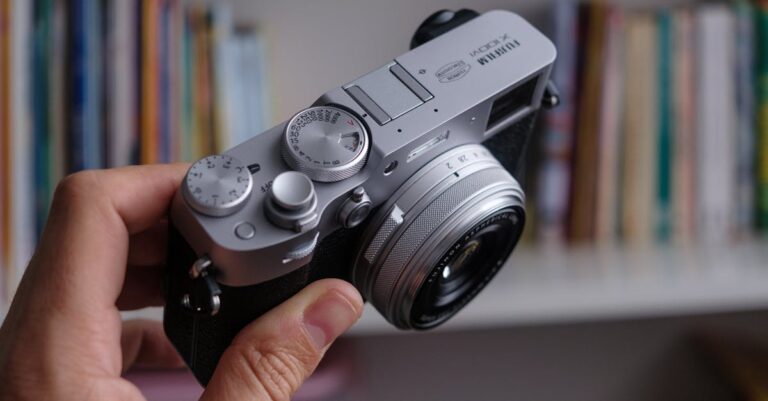
In the burgeoning world of mirrorless cameras, two models stand out for amateur photography: the Olympus OM-D E-M10 Mark IV and the Fujifilm X-T30. Each embodies a different vision of the compromise between aesthetics, performance, and budget, while appealing to audiences with varied expectations. These two portable, retro-styled cameras are back in 2025, witnessing a revival for those who want to combine aesthetic pleasure with technical efficiency. The central question remains: which model should you choose to capture the beauty of everyday life, whether during travel, a portrait, or an urban scene?
Design, ergonomics, and feel in the hand: two retro worlds, two approaches
Choosing a camera is also a question of feel. Tactile feel, ease of use, and handling—these are the elements that often determine affinity with a camera. The Olympus OM-D E-M10 Mark IV, like many modern-day models, retains a design inspired by classic SLRs, with a compact, rounded silhouette and ergonomics designed for stability. Its lightweight yet robust alloy body, combined with physical buttons, provides a reassuring grip for everyday photography.

LECTURE SUGGÉRÉE
OM System OM-5 vs Canon EOS R10: Which One to Choose for Your Photography?
Om System OM-5 vs. Canon EOS R10: A Duel of the Titans for Photography Enthusiasts…
LIRE L'ARTICLEFor its part, the Fujifilm X-T30 follows this vintage trend, with manual controls reminiscent of film cameras. Its pronounced grip, smaller dimensions, and light weight make it an ideal companion for traveling light. Beyond the shape, each camera offers a different control layout: Fuji favors manual controls with dedicated dials for shutter speed, ISO, and exposure, which often appeals to enthusiasts looking for the tactile feel of old-fashioned cameras.
Photography enthusiasts will attach particular importance to the button layout, easy access to quick settings, and the position of the viewfinder eyepiece. Compatibility with a variety of lenses also plays a role, particularly with Olympus, which offers a range of Micro Four Thirds lenses that are as compact as they are powerful. Criteria
| Olympus OM-D E-M10 Mark IV | Fujifilm X-T30 | Weight |
|---|---|---|
| 1.3 kg | 383 g | Dimensions |
| 122 x 84 x 49 mm | 118 x 83 x 47 mm | Control Type |
| Physical, buttons and dials | Manual with dials and menus | Sensor and Image Quality: In Pursuit of Perfection |
The heart of a camera remains its sensor, the true showcase of image quality. The Olympus OM-D E-M10 Mark IV features a 20.3-megapixel Micro Four Thirds sensor, sufficient to produce rich and detailed images, especially in bright environments. Its smaller size, compared to the Fujifilm X-T30’s APS-C sensor, nevertheless impacts noise management in low light. Since its launch, the Micro Four Thirds sensor has seen many improvements, particularly in dynamics and color reproduction, making this formula increasingly competitive for street and landscape photography.
The Fujifilm X-T30 features a larger 26.1-megapixel Bayer CMOS sensor, providing better light capture, even in challenging conditions. Its signature APS-C sensor is often praised for its color accuracy and low noise at high ISO sensitivity. The size difference—23.5 x 15.6 mm versus 17.4 x 13 mm—allows Fuji to leverage greater dynamic range, essential for landscape, architectural, and portrait photography.

Fujifilm X-H2S vs Sony A7 IV: Why choose one over the other?
A heated rivalry between two photography giants in 2025 As the digital camera market continues to accelerate, two models are…
CONTINUER LA LECTUREAnother dimension is compatibility with a diverse range of lenses. Olympus offers a collection of over 100 lenses, often affordable, allowing enthusiasts to explore a variety of styles. Fuji, more focused, focuses on high-quality optics, with around fifty models, often more expensive but highly specialized. Better low-light handling for Fuji
Greater dynamic range and detail for Fuji
- Lightness and compactness for Olympus
- Expanded lens range for Olympus
- Autofocus: precision and speed to capture life in motion
- Autofocus (AF) often makes a decisive difference, especially when it comes to scene or sports photography. Fuji’s technology is based on a hybrid system combining phase and contrast, equipped with 425 autofocus points, allowing it to effectively track moving subjects, thanks in particular to eye detection. Its fast focusing speed and ability to keep the subject in the viewfinder make it an ideal tool for dynamic photography.
The Olympus OM-D E-M10, with its 121 contrast points, prioritizes the precision of static or slow-moving images. Its system, which lacks phase detection, is often less efficient in fast-moving or low-light conditions. However, for quiet scenes or in a studio, this technology remains reliable and appreciated by those who prioritize stability.
And in practice? When shooting in a busy market or a moving portrait, the difference is noticeable. Fuji captures images faster, with greater responsiveness. Eye detection allows for sharp portraits, even in difficult conditions. With Olympus, focusing remains reliable, but sometimes requires increased patience, especially in low light. Features
Olympus OM-D E-M10
Fujifilm X-T30
| Autofocus System | Contrast, 121 points | Hybrid, 425 points with phase detection |
|---|---|---|
| Focus Speed | Moderate, suitable for static scenes | Ultra-fast, ideal for sports and urban life |
| Viewfinder and Screen: See clearly, frame precisely | In outdoor or street art photography, the comfort of the viewfinder and screen plays a crucial role. The Olympus OM-D E-M10 IV features an OLED electronic viewfinder with a resolution of 2,360,000 dots, delivering a clear and precise image. Its 180-degree rotating touchscreen makes it easy to shoot from any angle, perfect for selfies or vlogging. | The Fujifilm X-T30, equipped with an equally excellent OLED viewfinder, offers 100% coverage of the scene when composing. Its screen, also touch-sensitive and adjustable, allows for simplified menu navigation and precise focusing, even in selfie mode. The difference, if we want to make a reference, lies mainly in the ergonomics of the menu: Fuji favors a very intuitive interface, admirable for beginners. |
https://www.youtube.com/watch?v=pAxofRM63O8
Shooting Speed, Capturing the Moment, or Street Noise
A real priority for many enthusiasts, the ability to capture a fleeting moment can make all the difference between a failed photo and a remarkable one. Shooting speed, expressed in fps (frames per second), is a key parameter. The Fuji X-T30 achieves an impressive 30 fps in electronic mode, ideal for capturing fast-moving scenes, such as a sporting event or an urban ballet.
Specifications
Olympus OM-D E-M10
Fujifilm X-T30
Burst Speed
| 8.7 fps | 30 fps | Recording Capacity |
|---|---|---|
| Sufficient for casual shots | Ideal for action photography | Discover our comprehensive comparison guide to help you make informed decisions. Whether for products, services, or prices, we provide detailed analyses and reviews to guide you toward the best available options. |
| Stabilization and Video: Capturing Every Move with Finesse | Quality videos often require effective stabilization. The Olympus OM-D E-M10 Mark IV features 5-axis image stabilization, a real asset for amateur videographers. It allows for handheld filming, even in fast-moving environments or low light, thus avoiding unpleasant camera shake. | In contrast, the Fujifilm X-T30, which lacks a built-in stabilization system, relies on stabilized lenses or external accessories, such as gimbals. In terms of video capabilities, Fuji offers 4K UHD recording at 30p, with a bitrate of 200 Mbps for cinematic quality. Audio support is also enhanced thanks to its built-in microphone and headphone ports. |

Criteria
Olympus OM-D E-M10
Fujifilm X-T30
Stabilization
| 5-axis, effective for video | Absent, requires accessories | Video Quality |
|---|---|---|
| 4K UHD at 30p, 102 Mbps | 4K UHD at 30p, 200 Mbps | Ecosystem, Lenses, and the Future of Amateur Photography |
| Beyond technical specifications, choosing a camera also depends on compatibility with other equipment. Olympus, with its Micro Four Thirds system, boasts an extremely well-developed catalog. Compatibility with a variety of affordable lenses, many designed for travel or macro photography, makes it a flexible platform. | Fujifilm, a master of color reproduction and image sharpness, focuses on a more selective yet high-quality range of lenses. The brand’s philosophy favors artistic rendering, perfect for those who want a precise ambiance in every shot. | Both brands offer constant updates, with ever-increasing software integration, and anticipate innovations in artificial intelligence for subject tracking or preset automation. The future also hinges on online services, smartphone connectivity, and compatibility with video accessories or stabilizers. |
Wide variety of lenses for Olympus
Signature color rendering for Fuji
Intuitive interface combined with a complete ecosystem
Compatibility with modern video accessories
- Price, robustness, and value for money: the debate in 2025
- Price often remains the deciding factor. The Olympus OM-D E-M10 Mark IV, priced around €700, offers an excellent entry-level model, particularly for its built-in stabilization and lightweight design. It meets the needs of enthusiasts looking for a versatile companion without breaking the bank.
- For its part, the Fujifilm X-T30, often priced around €900, boasts superior image quality, precise autofocus, and advanced video capabilities. The price difference can be justified by its optical quality, dynamic range, and compatibility with high-end lenses.
- In terms of durability and construction, both fall into the rugged category. However, neither is fully weather-sealed, which may disappoint those looking to use their camera in harsh outdoor conditions. Key Features
Olympus OM-D E-M10
Fujifilm X-T30
Approximate Price
€700
| €900 | Value for money | Excellent for a limited budget |
|---|---|---|
| Best for image and video quality | FAQ: Everything you need to know to choose between Olympus and Fujifilm | Which camera is best for landscape photography? |
| The Fujifilm X-T30, thanks to its APS-C sensor and superior dynamic range, offers optimal quality for landscapes and architecture. | Which is the best option for video in 2025? | The Olympus’s built-in stabilization makes it a preferred choice for amateur video, but Fuji offers better audio handling and higher bitrates. |
Should you prioritize weight or ergonomic performance?
- If you travel a lot or practice street photography, the Fujifilm X-T30’s lightness can make all the difference. For more sedate use, the Olympus offers more reassuring ergonomics. Are both cameras weather-resistant? No, they are primarily designed for use in controlled environments, but accessories such as cases or covers can improve their durability.
- Which accessories or lenses should you prioritize in 2025? Olympus’s compatibility with a wide, affordable range makes it very attractive for macro and long focal length lenses. For Fuji, high-end lenses provide an indelible artistic signature.